
DBT-100 LS
Dual-effect heat-stable probiotics and post-genetic growth promoters
Gut health and antibiotic alternative solutions specifically designed for pigs and poultry
Product Introduction
DBT-100 LS is a dual-effect heat-stable probiotic and postbiotic feed additive developed DaBomb Protein Biotech Corp. for economically important animals such as pigs and poultry, combining two complementary mechanisms of action:
- Antibacterial spore-forming bacteria BA207: It can colonize the intestines and inhibit a variety of common pathogens, maintaining the balance of intestinal microbiota.
- Lactic acid bacteria postbiotic L022: It regulates immune response, reduces intestinal inflammation, and enhances the overall disease resistance of animals through the metabolites of lactic acid bacteria.
The two ingredients work synergistically, exerting their effects simultaneously at both the intestinal protection and systemic immunity levels, effectively reducing animals' dependence on antibiotics. This represents a concrete solution for promoting antibiotic-free feeding in modern animal husbandry. Furthermore, DBT-100 LS utilizes heat-resistant spore-forming technology, capable of withstanding feed pelleting processes at 120°C. This ensures the stability of probiotic activity and postbiotic functional components from the factory to the feed trough, making it one of the few dual-effect products in the industry truly applicable to commercial feed production systems.
Core Product Advantages
Effectively inhibits a variety of common intestinal pathogens
Tests show that DBT-100 LS has a clear inhibitory effect on the most common intestinal pathogens in livestock and poultry production, covering Escherichia coli, Salmonella, Staphylococcus aureus, Clostridium difficile, and Treponema pallidum, providing comprehensive protection against intestinal bacterial threats.
Improve feed conversion ratio and enhance the economic benefits of aquaculture.
The broiler chicken trial showed that the feed conversion ratio decreased from 1.33 to 1.22 after adding DBT-100 LS, an improvement of about 8%; when faced with Clostridium difficile infection challenge, the feed conversion ratio of chickens with added DBT-100 LS was also significantly better than that of the control group (1.59 vs 1.75).
Survival protection in critical situations
In piglet trials, the survival rate of the control group exposed to lipopolysaccharide toxin (Gram-negative bacterial endotoxin) was only 17%; the survival rate of the experimental group with added DBT-100 LS remained at 100% under the same toxin challenge, demonstrating the product's strong protective ability under severe immune stress.
Strengthen the immune system and reduce intestinal inflammation
Postbiotic L022 continuously regulates host immune signal transduction, activates immune cell function, and inhibits excessive inflammatory response, helping animals maintain a stable intestinal environment under high stress.
Stability of high-temperature process at 120°C
Using spore-forming probiotic technology, it can withstand the high temperatures of feed pelleting, ensuring that the number of effective live bacteria in each batch of feed is not significantly reduced due to the manufacturing process, so that the labeled efficacy can truly reach the animal's intestines.
Technical Principles | Dual-Layer Protection from Probiotics and Metabiotics
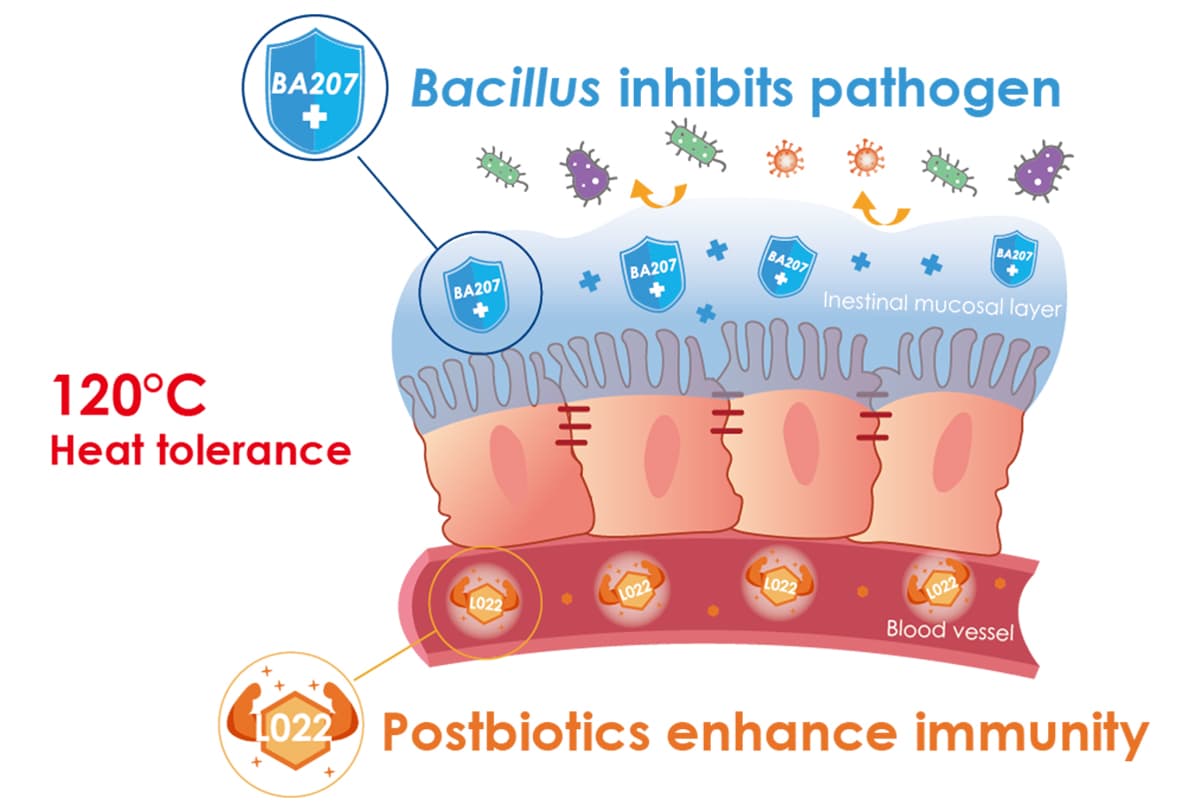
This schematic diagram, presented from the perspective of an intestinal cross-section, illustrates the two-layered sites of action and mechanisms of DBT-100 LS in an animal.
The upper part of the diagram focuses on the intestinal mucosa. The probiotic BA207 (blue shield icon) densely colonizes the mucosal surface, preemptively occupying attachment sites through a competitive exclusion mechanism. Simultaneously, it secretes antibacterial substances, preventing pathogens such as E. coli, Salmonella, and Treponema pallidum (various colored icons) from gaining a foothold in the intestinal wall. This is the first layer of DBT-100 LS's intestinal defense line—directly intercepting pathogens at the first point of invasion.
The lower half of the diagram illustrates the role of the vascular layer. Epigenetic L022 (the orange hexagonal diagram) is not a live bacterium, but rather a bioactive substance produced by lactic acid bacteria metabolism. Once in the circulatory system, it continuously regulates the host's immune signal transduction, maintains the good responsiveness of immune cells, and inhibits excessive inflammatory responses. This is the second layer of protection—strengthening the animal's overall disease resistance from a systemic immune perspective.
The label on the left of the image indicates "120°C heat stable," highlighting the prerequisite for the above dual mechanisms to truly function: DBT-100 LS must retain sufficient live bacteria count and postbiotic activity after the high-temperature pelleting process of the feed in order for the efficacy to be fully delivered to the animal's intestines.
[Figure 1: Schematic diagram of the dual-effect mechanism]
Research data and experimental results
Experiment 1 | Evidence of Antibacterial Action: Direct Differences Visible in Petri Dishes
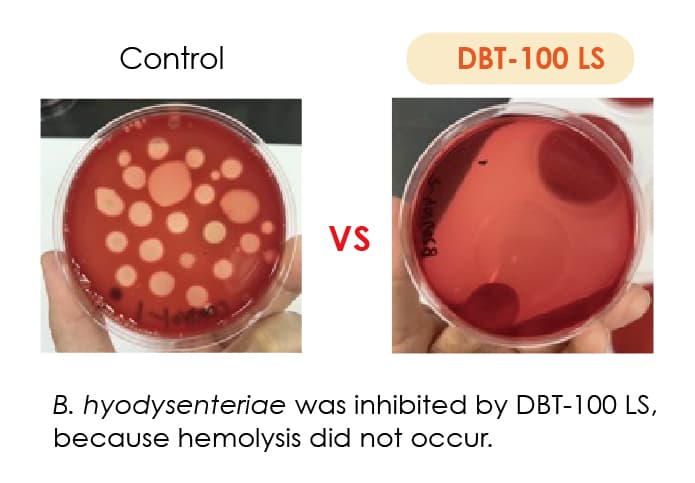
This set of images presents the actual results of an in vitro antibacterial test. The left side shows the control group without any treatment, and the right side shows the experimental group with DBT-100 LS added.
The experimental strain was *Brachyspira hyodysenteriae*, a major pathogen of swine dysentery, an intestinal disease in pigs. It can damage the large intestinal mucosa and cause hemorrhagic diarrhea, making it one of the intestinal pathogens that cause significant losses in pig farming.
The key to interpreting these images lies in the white transparent halo (hemolytic zone) on the petri dish. When the swine dysentery spirochetes grows on blood culture medium (red medium in the image), it breaks down the red blood cells in the medium, forming a clear white transparent halo around the colony—this halo is called the "hemolytic zone" and is a visual indicator that confirms the bacterium's active infectivity.
[Figure 2: Comparison of culture dishes in the antibacterial test of Spirochetes in swine dysentery]
Control group (left image): The culture dish is covered with a large number of white hemolytic zones, indicating that the swine dysentery spirochetes are proliferating rapidly, actively hemolyzing, and highly infectious.
DBT-100 LS experimental group (right figure): The hemolysis zone is almost invisible on the culture dish, indicating that the growth of swine dysentery spirochetes is significantly inhibited by DBT-100 LS and hemolysis does not occur.
The text below the image states: "The swine dysentery spirochetes were inhibited by DBT-100 LS because hemolysis did not occur." This is an intuitive visualization result—the difference between the two images on the petri dish is a direct representation of the antibacterial effect of DBT-100 LS.
Experiment 2 | Broiler Chicken Experiment: Increased Feed Replacement Rate
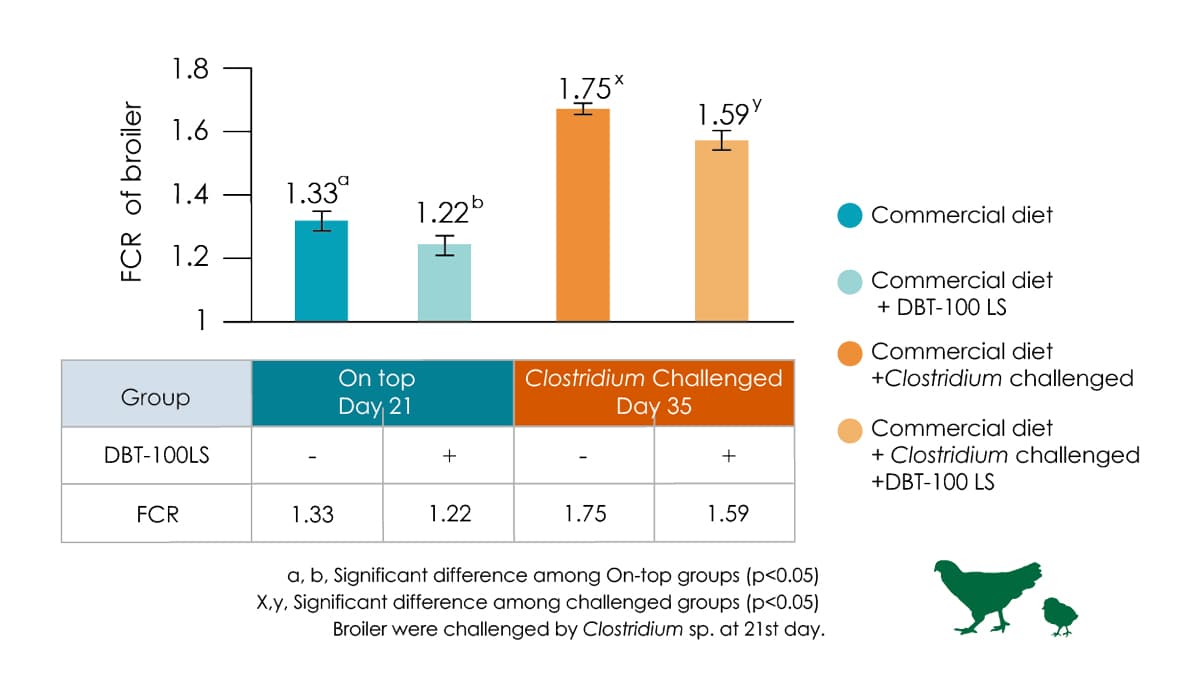
This chart compares the feed conversion ratio (FCR) of broiler chickens under two different scenarios, with a total of four experimental groups. The lower the FCR value, the higher the feed utilization efficiency—the more chicken meat produced with the same feed input.
The two groups on the left (blue tones, routine addition experiment, day 21): Dark blue bar (normal commercial feed, without DBT-100 LS): Feed conversion ratio = 1.33; Light blue bar (commercial feed + DBT-100 LS): Feed conversion ratio = 1.22. Under normal feeding conditions, simply adding DBT-100 LS reduced the feed conversion ratio from 1.33 to 1.22, an improvement of approximately 8.3%. The letters above the bars (a and b are different) indicate that the difference between the two groups has reached a statistically significant level, and is not a coincidence.
[Figure 3: Bar chart of feed conversion ratio experiment for broiler chickens (including Clostridium difficile infection challenge)]
The two groups on the right (orange, Clostridium spp. infection challenge, day 35): Clostridium spp. is one of the main pathogens of gangrenous enteritis in poultry. After infection, the chicken's intestines are damaged, its digestive and absorptive capacity is greatly reduced, and the feed conversion ratio deteriorates. The experiment artificially infected chickens with Clostridium spp. on day 21 to simulate the actual infection situation in a poultry farm.
Dark orange column (infected group, without DBT-100 LS): Feed conversion ratio = 1.75, significantly worse than the 1.33 of normal feeding, indicating that infection indeed severely impacts the feed utilization efficiency of chickens. Light orange column (infected group + DBT-100 LS): Feed conversion ratio = 1.59, although still higher than the uninfected state, it is significantly improved compared to the infected group without DBT-100 LS, and the difference between the two groups is statistically significant (X and y are different letters).This data demonstrates that DBT-100 LS is effective in two scenarios: it can improve feed efficiency under normal circumstances and buffer the impact of disease on growth performance during infection, minimizing losses.
Experiment 3 | Piglet Experiment: Increased Survival Rate Under Toxin Attack
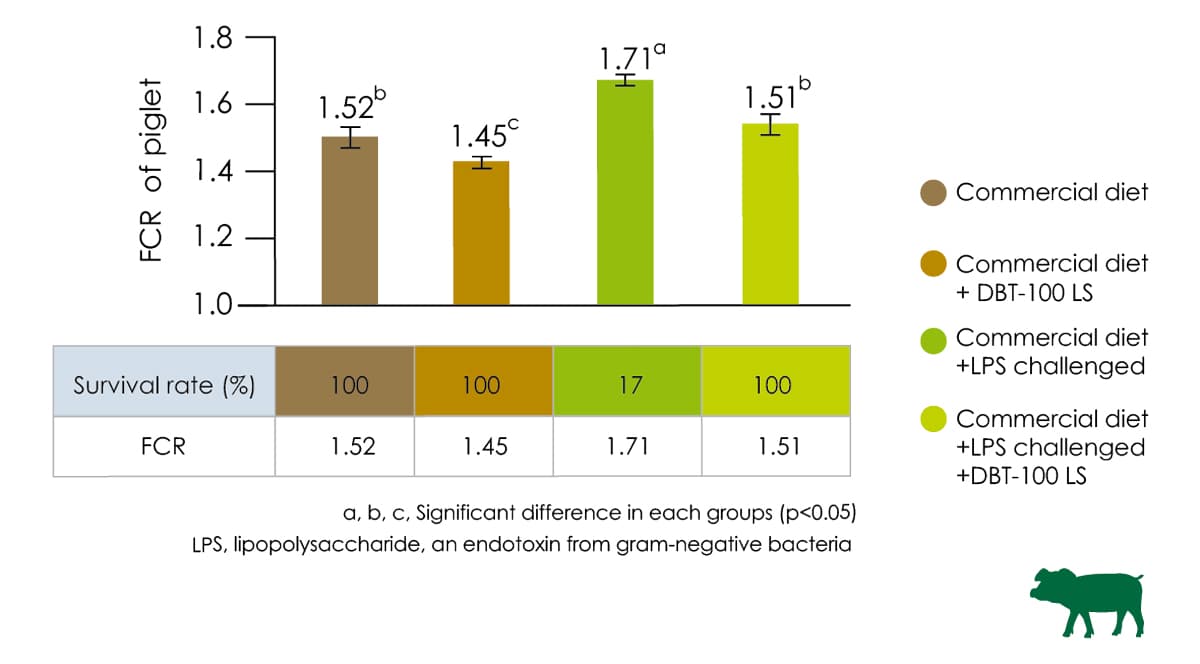
This chart contains the most striking set of experimental data on this page, with the key figures appearing in the table below: survival rates ranging from 17% to 100%. The experiment consisted of four groups, using piglets as subjects:
Brown column (general commercial feed): Feed conversion ratio 1.52, survival rate 100%.
Dark orange column (commercial feed + DBT-100 LS): Feed conversion ratio 1.45, survival rate 100%.
Bright green bar (commercial feed + lipopolysaccharide toxin challenge): feed conversion ratio 1.71, survival rate 17%.
Yellow-green column (commercial feed + lipopolysaccharide toxin + DBT-100 LS challenge): Feed conversion ratio 1.51, survival rate 100%.
[Figure 4: Bar chart of feed conversion ratio and survival rate in piglets (lipopolysaccharide toxin challenge)]
Lipopolysaccharide (LPS) is a component of the cell wall of Gram-negative bacteria (such as Escherichia coli). When animals are severely infected by these bacteria or when intestinal permeability increases, LPS enters the bloodstream in large quantities, triggering a strong systemic inflammatory response, known as "endotoxemia," which is a highly fatal pathological mechanism in piglets with infectious enteritis or systemic infections.
The results showed that piglets challenged by lipopolysaccharide toxin had a mortality rate as high as 83% without the addition of DBT-100 LS, with only 17% surviving. Under the same toxin challenge conditions, the survival rate of piglets with DBT-100 LS was maintained at 100%, and the feed conversion ratio (1.51) was not only much lower than that of the unprotected group (1.71), but also quite close to that of the general commercial feed group (1.52).
This set of data demonstrates the protective efficacy of DBT-100 LS under severe immune stress from two dimensions: survival rate and growth efficiency. It is not just a "nice-to-have" to improve feed efficiency under normal conditions, but also an indispensable safety net in high-risk infection environments.
The letters (a, b, c) above the bars in the figure represent statistical significance markers. The differences between groups with different letters have reached the statistical significance level (p<0.05), meaning that the observed differences are real and reproducible, rather than accidental.
Inhibitory intestinal pathogens
DBT-100 LS has been experimentally verified to inhibit the following common intestinal pathogens in livestock and poultry:
- E. coli
- salmonella
- Staphylococcus aureus
- Clostridium
- Swine dysentery spirochetes
Application areas
DBT-100 LS is specifically designed for feed formulations of economically important animals such as pigs and poultry. It is suitable for the following animals:
- Pigs: Piglet feed, nursery pig feed, growing and finishing pig feed
- Poultry: broiler chickens, laying hens, breeding chickens
Especially suitable for:
- Preventive health management during peak periods of intestinal diseases
- Supporting programs for antibiotic-free feeding or antibiotic reduction strategies
- Intestinal health maintenance in high-density housing environments
- Optimization of feed conversion ratio and control of breeding costs
Recommended dosage
| Species | Recommended addition amount |
| White meat chicken | 150-250 g/metric ton of feed |
| piglets | 300-500 g/metric ton of feed |
| Growing-finishing pigs | 150-300 g/metric ton of feed |
Product Specifications
| project | illustrate |
| probiotic strains | Bacillus subtilis BA207 |
| Probiotic count | ≥10⁹ colony-forming units/gram |
| Functional ingredients | Lactic acid bacteria postbiotic L022 |
| thermal stability | Tolerate 120°C |
| Package | 25 kg/bag |
| Minimum shipment quantity | 1 ton |
| Shelf life | 24 months |
| Countries that have already exported | India/Vietnam/Malaysia |
Frequently Asked Questions (Q&A)
Q1: Is DBT-100 LS a probiotic or an epigenetic product? What are the advantages of having both?
DBT-100 LS contains both probiotics (live Bacillus subtilis BA207) and metabolites (metabolites of Lactobacillus L022), creating a synergistic dual-effect formula. The probiotics colonize directly in the gut, preventing pathogens from occupying the mucosa through a competitive elimination mechanism and secreting antibacterial substances to inhibit the proliferation of harmful bacteria. The metabolites, on the other hand, enter the circulatory system as metabolites, continuously regulating the systemic immune response and reducing intestinal inflammation. These two mechanisms act on the "gut frontline defense" and "systemic immune regulation" levels respectively, providing a more comprehensive effect than a single mechanism and filling the gaps in the effects of pure probiotics or pure metabolites.
Q2: Can DBT-100 LS replace antibiotics? Which antibiotic-free feeding strategies is it suitable for?
DBT-100 LS is a functional feed additive positioned as a preventative intestinal health management tool, not a therapeutic drug. Therefore, it cannot replace emergency antibiotic treatment when disease has already occurred. However, at the preventative level, DBT-100 LS reduces the likelihood of animal infection by inhibiting various common intestinal pathogens such as E. coli, Salmonella, Clostridium, and Treponema pallidum, while also strengthening the immune system, effectively reducing the need for antibiotics. It is suitable as a core supporting solution for the following scenarios: promoting antibiotic-free farming (zero antibiotic addition) certification, antibiotic reduction programs, compliance with drug residue regulations in export markets, and organic livestock certification applications.
Q3: Which intestinal pathogens does DBT-100 LS inhibit?
Experiments have verified that DBT-100 LS has a clear inhibitory effect on the following five common intestinal pathogens in livestock and poultry: Escherichia coli, Salmonella, Staphylococcus aureus, Clostridium, and Treponema pallidum, the pathogen of swine dysentery. In particular, the antibacterial test results of Treponema pallidum culture dishes showed that after adding DBT-100 LS, the culture dishes showed almost no hemolysis, while the control group was covered with obvious hemolysis zones, demonstrating a clear antibacterial effect.
Q4: How much can DBT-100 LS improve feed conversion ratio?
According to the results of the broiler chicken trials, under normal feeding conditions, the addition of DBT-100 LS reduced the feed conversion ratio from 1.33 to 1.22, an improvement of approximately 8.3%. Under the challenge scenario of artificial Clostridium perfringens infection, the feed conversion ratio in the added group was 1.59, a significant improvement compared to the 1.75 in the untreated group. In the piglet trials, the feed conversion ratio in the normal addition group decreased from 1.52 to 1.45. Under the lipopolysaccharide toxin challenge, the feed conversion ratio in the added group (1.51) was also far superior to the unprotected infected control group (1.71). Overall, the benefits of DBT-100 LS were validated in both the "efficiency improvement under normal feeding conditions" and "loss buffering during infection" scenarios.
Q5: Under what circumstances did the survival rate of piglets increase from 17% to 100% in the piglet trial?
This study investigated the use of lipopolysaccharide (LPS) toxins (endotoxins from the cell walls of Gram-negative bacteria) to challenge piglets. When large amounts of LPS enter the bloodstream, they trigger a severe systemic inflammatory response (i.e., "endotoxemia"), one of the leading causes of death in piglets with infectious enteritis or systemic infections. The results showed that piglets without DBT-100 LS had a mortality rate as high as 83% under LPS challenge; while piglets supplemented with DBT-100 LS maintained a 100% survival rate at the same toxin dose. This result demonstrates that DBT-100 LS's strengthening of the intestinal barrier and pre-activation of the immune system provide crucial protection against severe infections or toxin attacks, rather than only functioning under normal healthy conditions.
Q6: Is DBT-100 LS still effective after high-temperature feed processing?
Yes, this is one of the core considerations in the design of DBT-100 LS. The product uses spore-forming Bacillus subtilis (BA207), whose spore structure gives it extremely strong heat tolerance, allowing it to withstand feed pelleting processes at 120°C, thus preserving the activity of the probiotics after processing. The post-biotic L022 is a metabolite, not a live bacterium, and its structure is inherently stable, also unaffected by high-temperature processing. Compared to many commercially available probiotics that suffer from a significant reduction in live bacteria count and compromised efficacy after high-temperature pelleting, DBT-100 LS's heat stability ensures the complete preservation of the active ingredients in each batch of commercial feed from raw materials to finished product.
Q7: What is the difference between DBT-100 LS and DBT-100 HT for aquaculture?
Both products use the same core probiotic strain (BA207) and postbiotic (L022) platform technology. The main differences lie in their target applications and formulation design. DBT-100 HT is designed for aquaculture (shrimp, fish), with test data covering anti-white spot virus, Vibrio clearance rate, and feed conversion ratio in aquaculture. DBT-100 LS is designed for terrestrial economic animals such as pigs and poultry, with test data covering Clostridium perfringens infection challenge (chicken), lipopolysaccharide toxin challenge (piglets), and antibacterial validation against various intestinal pathogens in livestock and poultry. It is recommended to choose the appropriate product based on the type of farmed animal.
Q8: In which feeding and management scenarios is the DBT-100 LS suitable for use?
The DBT-100 LS delivers its most significant benefits in the following scenarios:
- Preventative use: Supplement in advance during seasons when intestinal diseases are prevalent (such as high temperatures in summer, seasonal changes, and peak density periods) to reduce the chance of animals being infected by pathogens and maintain stable growth performance and feed efficiency.
- Antibiotic-free feeding kit: As a core feed component of antibiotic reduction or zero-addition strategies, it fills the gap in gut health management after the removal of antibiotics.
- High-stress feeding period: During feeding periods with high immune stress, such as weaning of piglets, regrouping, and peak density, supplementation should be given in advance to strengthen the animals' resistance to environmental stimuli.
- Post-infection recovery support: Supplement during the recovery period after an illness to help stabilize the gut microbiota and accelerate the animal's return to normal feed intake and growth rhythm.
For product samples, feed formulation consultation, or technical support, please contact DaBomb Protein Biotech Corp.