News & Updates
Timely updates on innovative technologies, product applications, and industry perspectives.
Explore the latest developments in bio-fermentation and precision nutrition.

- Home
- News
- Company News
- DaBomb Protein's Postbiotic Research Featured in AQUACULTURE Asia Pacific: Less Fishmeal, Same Shrimp Performance
DaBomb Protein's Postbiotic Research Featured in AQUACULTURE Asia Pacific: Less Fishmeal, Same Shrimp Performance
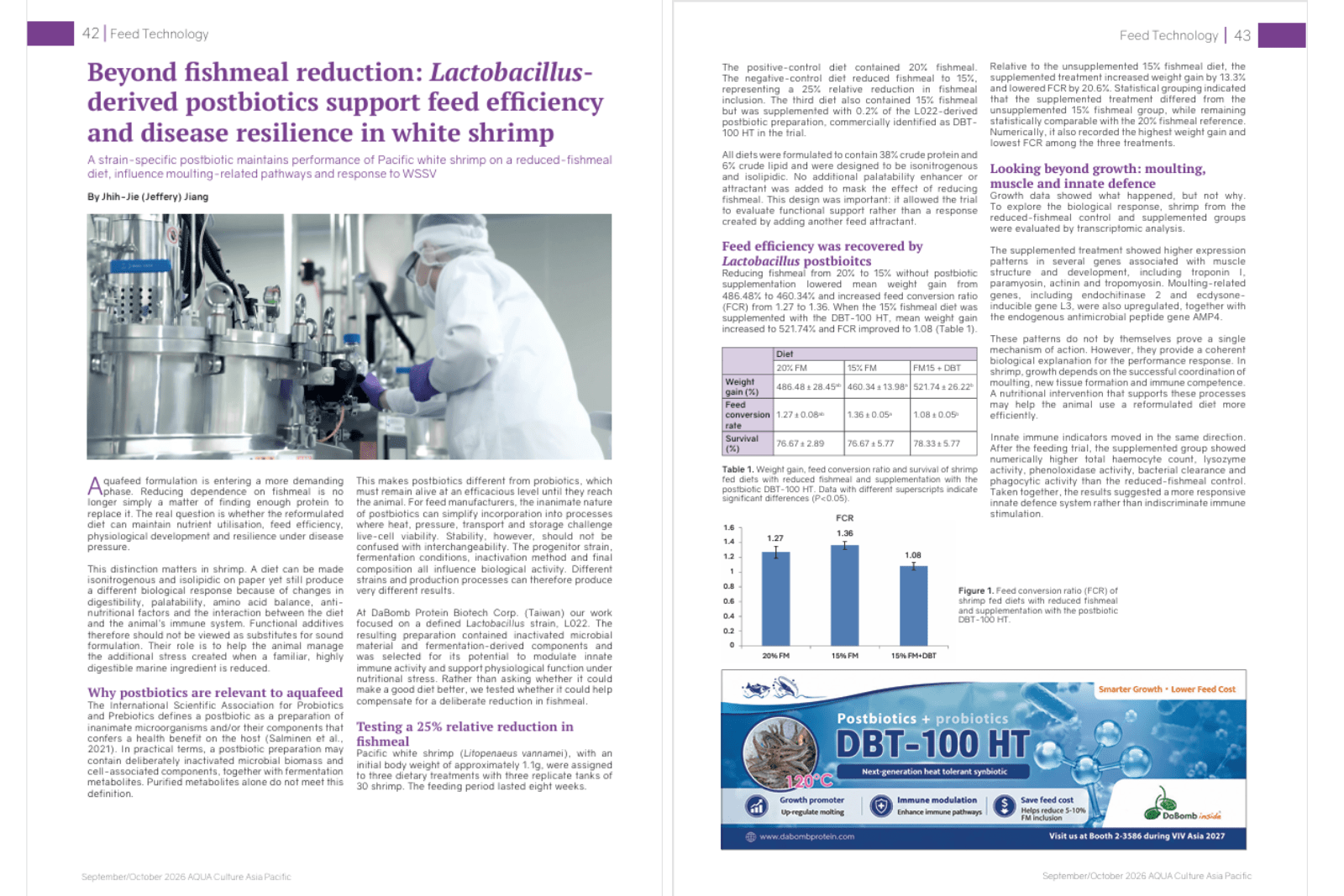
DaBomb Protein Biotech Corp. has published research in the September/October 2026 issue of AQUACULTURE Asia Pacific, an international aquaculture magazine. The article, "Beyond fishmeal reduction: Lactobacillus-derived postbiotics support feed efficiency and disease resilience in white shrimp," was written by Jhih-Jie (Jeffery) Jiang, our International Business Director.
As the aquafeed industry reduces its dependence on fishmeal, the new diets often bring problems with nutrient utilisation, feed efficiency and disease resistance. In this study we used DBT-100 HT, a postbiotic made from our own Lactobacillusstrain L022. We tested whether it could help Pacific white shrimp perform well again after fishmeal was deliberately reduced.
Trial Design
- Pacific white shrimp (Litopenaeus vannamei) with an initial body weight of about 1.1 g were fed for 8 weeks.
- Dietary fishmeal was reduced from 20% to 15%, a 25% relative reduction.
- The 15% fishmeal diet was supplemented with 0.2% DBT-100 HT.
- All diets contained 38% crude protein and 6% crude lipid, and no attractants were added.
Key Findings
- Growth and feed efficiency: Compared with the unsupplemented 15% fishmeal diet, DBT-100 HT increased weight gain by 13.3% (460.34% → 521.74%). It also improved the feed conversion ratio (FCR) by 20.6% (1.36 → 1.08). Both results were statistically comparable to the 20% fishmeal reference diet.
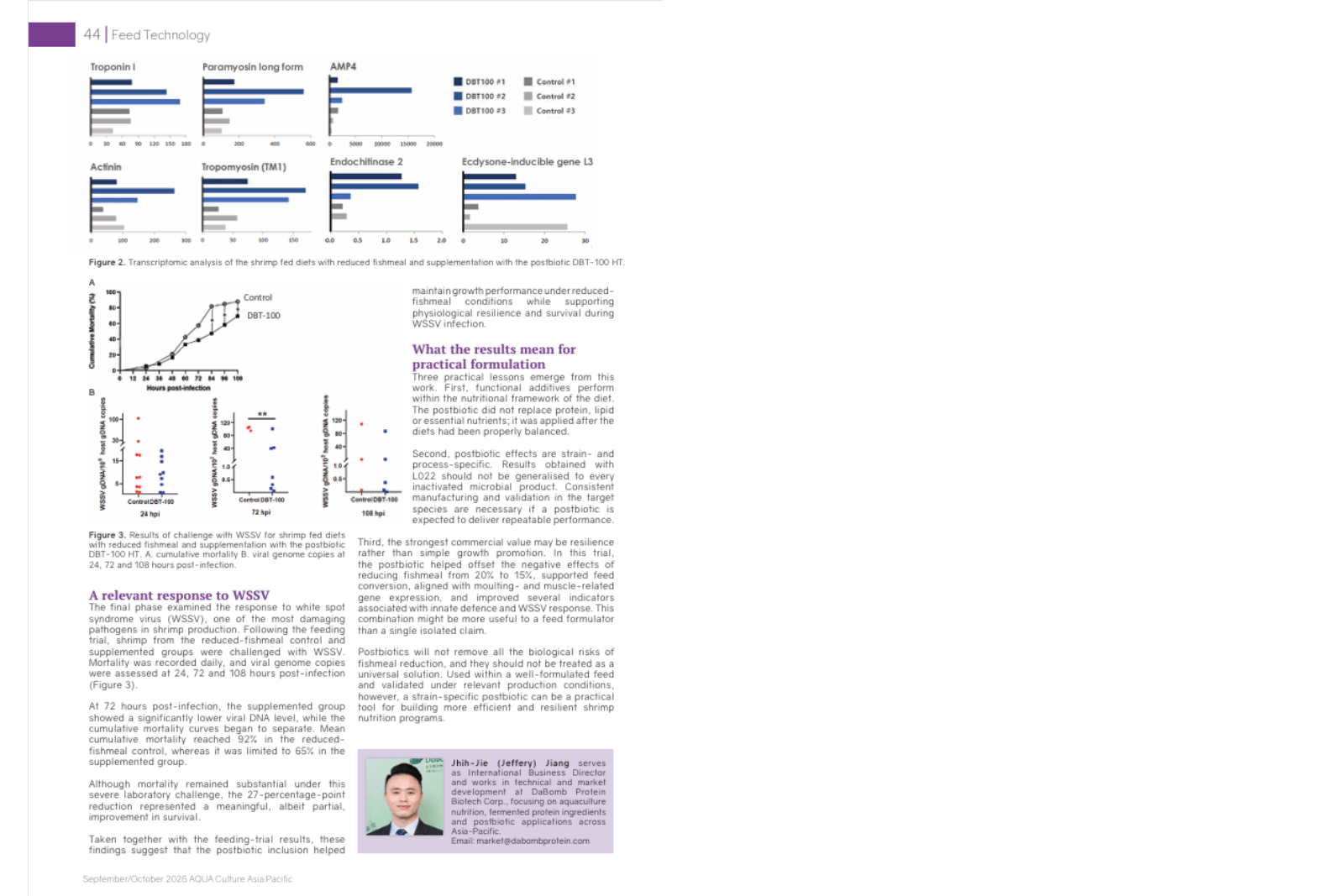
- Gene expression: Transcriptomic analysis showed higher expression of three groups of genes:
- muscle-development genes, such as troponin I and paramyosin
- moulting-related genes (endochitinase 2 and ecdysone-inducible gene L3)
- the antimicrobial peptide gene AMP4
- Innate immunity: Total haemocyte count, lysozyme activity, phenoloxidase activity, bacterial clearance and phagocytic activity were all numerically higher than in the control group.
- White spot syndrome virus (WSSV) challenge: At 72 hours post-infection, viral DNA levels in the supplemented group were significantly lower. In a severe laboratory challenge, cumulative mortality fell from 92% to 65%, a reduction of 27 percentage points.
These results show that a strain-specific Lactobacillus postbiotic, used in a well-balanced formulation, can help white shrimp keep their growth and feed efficiency when fishmeal is reduced. It also improves their resilience to disease. For feed manufacturers, this means fishmeal can be reduced while still keeping production costs and farm results stable.
See the full article in the images below.